
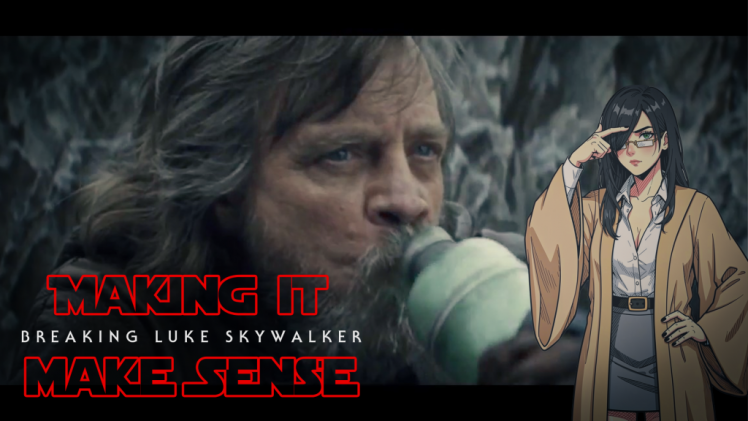
Making it Make Sense: Breaking Luke Skywalker
For myself and many others, one of the principal problems with the Star Wars Sequel Trilogy is that Luke feels horribly mischaracterised. He went from a brash, optimistic, heroic young man who resisted the urge to cut down his villainous father, time and time again, to a panicked uncle who tried to kill his still-innocent nephew seemingly at the first sign of trouble. That singular act taints everything else the film attempted to do with his arc, casting a blighted shadow over it that still looms today.
But, if we remove the murder attempt, I think we can still get to where Luke is by The Last Jedi another way - a way that stays true to who he was in the Original Trilogy but still rings true with an arc of an older man changed by time and history.
Let's say that after the Original Trilogy, the galaxy has put Luke on an enormous pedestal. He's the hero of the age now. The plucky young upstart who dealt the death blow to the Empire--destroying the Death Stars and defeating even the Emperor himself--is now a legend in the flesh. There's a mythos around him that's larger-than-life, and it weighs on him. He shrinks from it, but still does his best to leverage it into getting him what he needs to found the new Jedi Order.
For a time, all is golden, and he feels like he's managing the situation. He's on his island training new padawan, and the next generation is starting to come along nicely.
But then he senses it. The clouds around his nephew Ben.
Ben doesn't understand why the Jedi students don't use their power fully to solve problems. His approach is very much one of "the Force is a hammer and everything else is a nail." As with Anakin, Luke tries time and again to curb the boy's darker impulses, but the boy meets every moral and ethical challenge in precisely the wrong way. Luke can feel him slipping, slowly but surely.
Crucially, unlike what we got in the film, Luke does not give up on him, or try to fight him--at least until Ben forces his hand, attempting to commit one atrocity in order to stop another.
Luke fights not to kill, but to restrain. Even so, at the power and speed both these Force users have, they both start fighting more aggressively - Ben out of hubris and anger, Luke to keep up - and eventually Luke accidentally wounds the more inexperienced Ben, who much like Anakin, got cocky, moved in too close at the wrong moment and brought it on himself.
Ben is scarred mentally and physically, and flees. Luke blames himself for causing the injury, and for not being able to stop things from escalating to this point. He begins to question his own efficacy as a teacher and friend. We start to see the beginnings of the despair in him.
Then, when Ben returns, having fallen to the dark side, he slaughters the rest of the new Jedi before Luke can stop him.
Now Luke breaks. NOW, it feels realistic.
Luke here, did everything he could without betraying himself, but still couldn't pull out a win at the last moment. The methods that served him in The Empire Strikes Back with his father didn't work here. He feels like a complete failure at odds with the expectations both he and the galaxy at large have for himself.
Despondent, and feeling inadequate to the task, he echoes Yoda in Revenge of the Sith and decides to withdraw. Not give up, though. Or give up hope. (Not fully, anyway.) Just withdraw. Just as Yoda placed his faith in Obi-Wan and the children, Luke placed his faith in his sister, who is in the New Republic. He decides the Force has chosen her to carry on the battle, and, judging that he's personally not worthy to continue the fight himself, he puts away his lightsabre.
Thus we have Luke immersed in the dark night of the soul where find him in in The Last Jedi, full of self-doubt, cynicism and unwilling to engage. And where, of course, the next generation will eventually find him, remind him of who he is, and lift him out of it for his return before the end.
I find this character arc more realistic and mature. It doesn't take away the agency of the next generation, or diminish the feats and feelings of the last. It still keeps the cyclical nature of passing the torch, and still keeps Luke heroic as well as tragic without ruining who he is at the core in the process.
(You can also see in this video here they were at least thinking of some of this--the idea of the Hero's myth weighing on Luke as per Rey-- and I have no idea why they chose to not focus on this plotine more concretely.)
About Paisley P. Peinforte
A hater of Active voice, Lady Peinforte is titled nobility of the nation of Sealand. Having successfully invaded both America and Canada from her home base in Windsor, she has become horribly corrupted by the world, and is dedicated to "creating the greatest 'Ship of them all". She ponders horribly terrible, idiotic things for your amusement.

~explanation~
I'm a snarky, semi-horrible human being given to penning intentionally bad epic slashfiction involving improbable objects and individuals, with the ultimate ambition of befouling Kindle with it one day,which is ostensibly what this blog is for.
In practice, however, it tends to mainly be a circular file for my various thoughts and ideas, some whimsical and others not, in addition to my various Photoshop experiments, mainly collections of what I originally generated for Twitter but now do for Mastodon Threads Bluesky thanks to Twitter becoming a fascist hellscape.
I also have a sideproject doing art for my addition to Doctor Who fanon, Karnian Script which is a more sigil-based, witchy take on Galifreyan variants.